How Perforation Rate Affects Acoustic Panel Performance
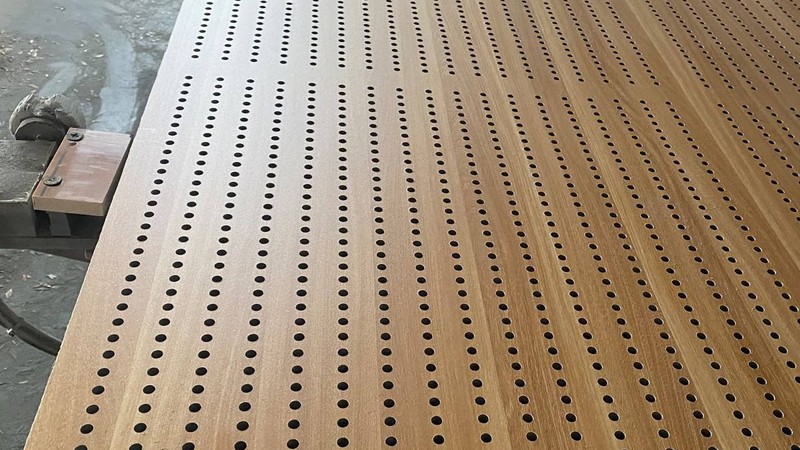
Perforation rate is the percentage of open area on the face and is a key design parameter. For Φ6 mm holes at 20 mm centre spacing in a straight grid, the rate is about 7%; at 15 mm spacing it rises to 12%; at 30 mm spacing it drops to about 3%. The perforation rate directly sets the resonance frequency, bandwidth and peak absorption coefficient.
Theoretically, lower perforation (3–5%) shifts the resonance peak toward low frequencies, with a higher but narrower peak, useful for attacking specific room modes in control rooms and home cinemas. Higher perforation (8–12%) moves and widens the peak toward mid-high frequencies, giving a flatter response and raising NRC from about 0.55 to above 0.75.
Measured data on 15 mm MDF with a 50 mm cavity and 48 kg/m³ glass wool shows: 3% perforation peaks near 0.90 at 250 Hz and falls to 0.4 above 500 Hz; 10% perforation holds 0.7–0.85 between 500–2000 Hz. This means the perforation rate should be back-calculated from the target absorption band rather than maximised blindly.
In practice, projects combine panels of different rates: low-perforation panels for low-frequency hotspots, high-perforation panels for mid-high reflection zones. Note that very high perforation reduces panel stiffness, so large-span ceilings need deflection checks; metal panels above 20% open area also need wind-load and access-panel verification.
— Mushu Wood Wool Acoustic Panel