Multi-layer Solid Wood Acoustic Panels: Structure and Advantages
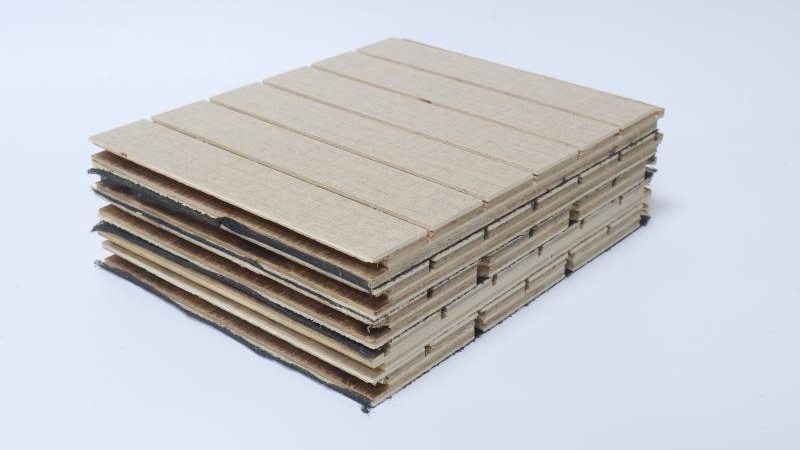
Multi-layer solid wood acoustic panels use plywood (LVL or veneer core) as substrate, typically glued from eucalyptus, poplar or pine veneers with phenolic resin and hot-pressed, then grooved or perforated on the face with a porous fleece backing. Common thicknesses are 15 mm and 18 mm, with 5–9 plies of 1.5–2.0 mm veneer each, static bending strength ≥30 MPa and modulus of elasticity ≥4500 MPa.
Compared with MDF, plywood offers better dimensional stability and warp resistance: the cross-laid veneers balance anisotropic swelling, so in humid southern or coastal projects the diagonal deformation is roughly one third of MDF equivalents. Screw-holding strength across the face is also higher, making repeated removal and reinstallation less likely to chip the edges.
Acoustically, 15 mm grooved plywood panels deliver NRC around 0.55–0.70, with 0.60 at 500 Hz, close to MDF versions. Because the substrate density is more uniform, batch-to-batch scattering of absorption coefficients is smaller, suiting studios, control rooms and multi-function halls that require consistent performance.
Environmentally, good plywood uses E0 phenolic adhesive with formaldehyde emission ≤0.05 mg/m³; faced panels reach B1 fire class, and aluminium-composite versions can reach A2. Installation typically uses light-gauge steel studs with 48 kg/m³ insulation at 400–600 mm spacing and a cavity ≥50 mm to unlock low-frequency absorption.
— Mushu Wood Wool Acoustic Panel